온라인문의
온라인문의

Bring the Resilience of Extreme Environments to Skin, Baengnok Biome
등록일 2026. 07. 27 조회수 9
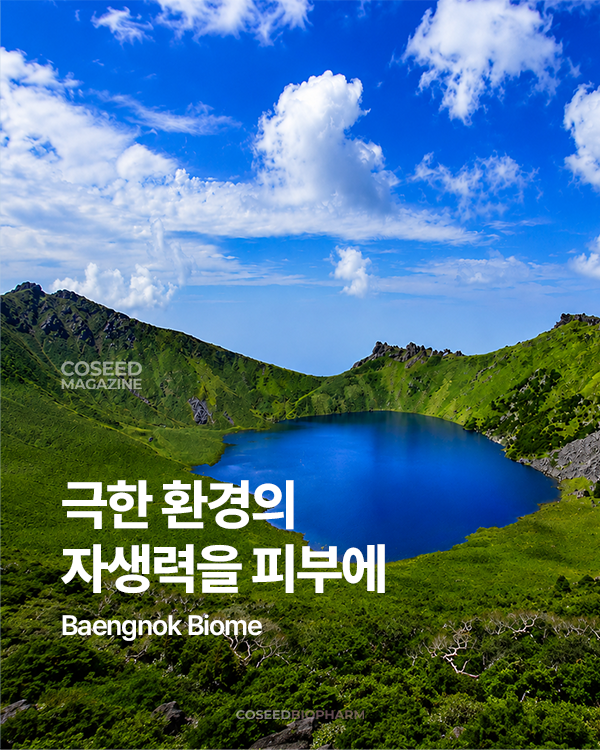
Baengnok Biome
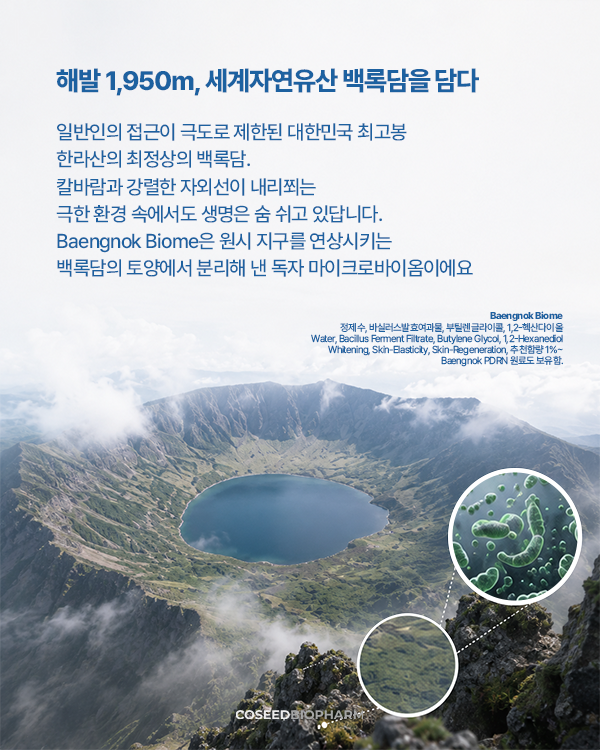
Born at 1,950 m in Baengnokdam, a UNESCO World Heritage Site
Located at the summit of Hallasan, Korea’s highest mountain, Baengnokdam is a place where public access is strictly restricted.
Even under extreme conditions marked by freezing winds and intense UV exposure, life continues to thrive.
Baengnok Biome is a proprietary microbiome ingredient isolated from the primordial soil of Baengnokdam.
Baengnok Biome
- INCI: Water, Bacillus Ferment Filtrate, Butylene Glycol, 1,2-Hexanediol
- Benefits: Brightening, Skin Elasticity, Skin Regeneration
- Recommended Use Level: 1% or higher
- Baengnok PDRN is also available.
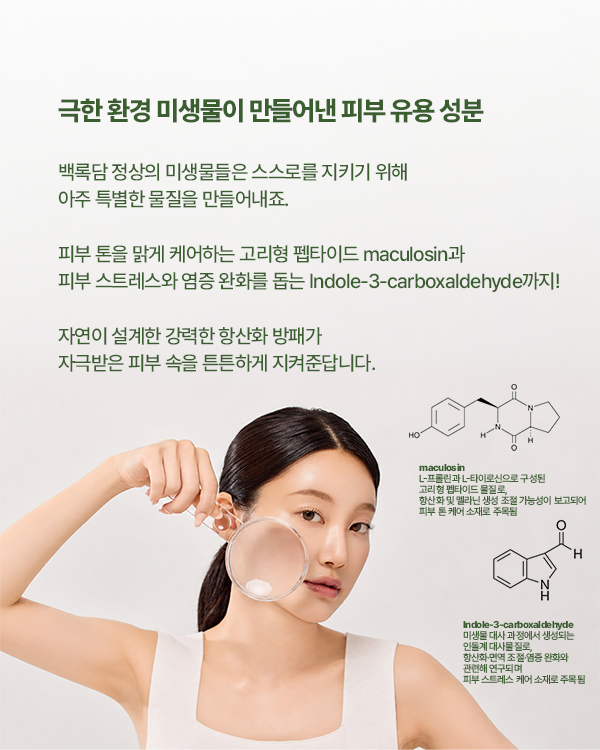
Skin-Beneficial Compounds Created by Microorganisms in Extreme Environments
Microorganisms living at the summit of Baengnokdam produce unique compounds to protect themselves.
These include maculosin, a cyclic peptide that supports a clearer-looking skin tone, and Indole-3-carboxaldehyde,
which helps relieve skin stress and inflammatory responses.
This powerful antioxidant defense system, designed by nature, helps reinforce and protect irritated skin.
Maculosin
A cyclic peptide composed of L-proline and L-tyrosine. Its potential antioxidant and melanin-regulating properties have been reported,
drawing attention as a promising skin tone care ingredient.
Indole-3-carboxaldehyde
An indole metabolite produced during microbial metabolism. It has been studied in relation to antioxidant activity,
immune modulation, and inflammation relief, making it a promising ingredient for skin stress care.
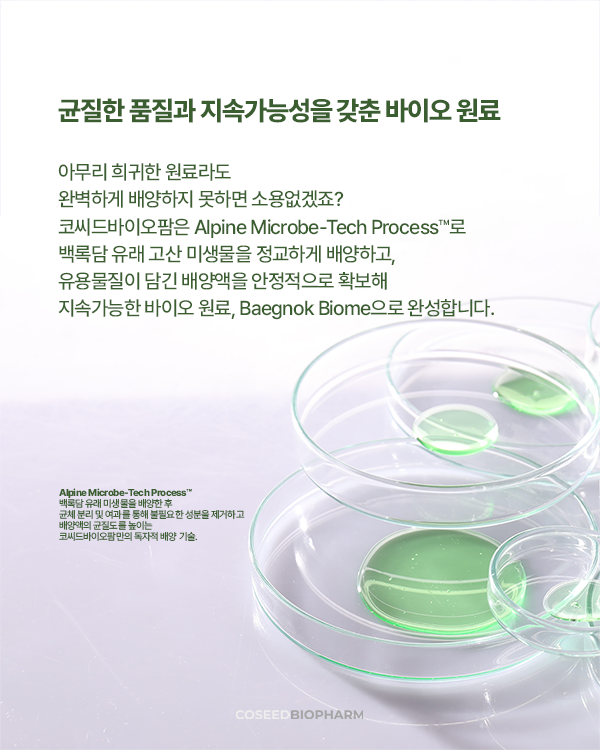
A Sustainable Bio-Ingredient with Consistent Quality
No matter how rare an ingredient may be, its value cannot be fully realized without precise and consistent cultivation.
Through its proprietary Alpine Microbe-Tech Process™, CoSeed BioPharm carefully cultivates alpine microorganisms originating from Baengnokdam and stably obtains a culture medium rich in beneficial compounds.
The result is Baengnok Biome, a sustainable bio-ingredient with consistently controlled quality.
Alpine Microbe-Tech Process™
CoSeed BioPharm’s proprietary cultivation technology, which removes unnecessary components through microbial cell separation
and filtration after cultivation, improving the consistency and uniformity of the culture medium.
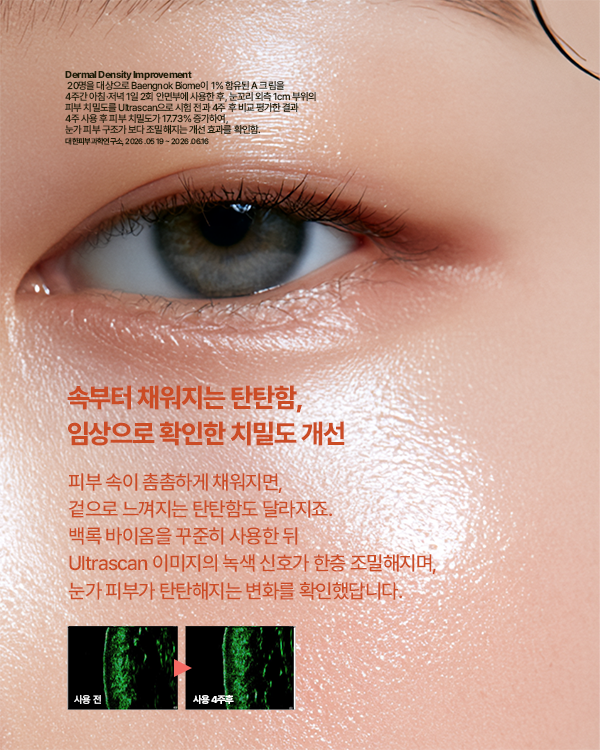
Firmness That Builds from Within
Clinically Demonstrated Improvement in Dermal Density
As the skin becomes denser from within, the firmness felt on the surface begins to change as well.
After consistent use of Baengnok Biome, the green signals in Ultrascan images appeared more densely distributed,
confirming an improvement in dermal density around the eye area.
Before Use / After 4 Weeks
Dermal Density Improvement
Twenty participants applied Cream A containing 1% Baengnok Biome to the face twice daily, morning and evening, for four weeks.
Dermal density was measured using Ultrascan at a point 1 cm from the outer corner of the eye before use and after four weeks.
After four weeks, dermal density increased by 17.73%, confirming a denser skin structure around the eye area.
Korea Institute of Dermatological Sciences
May 19–June 16, 2026
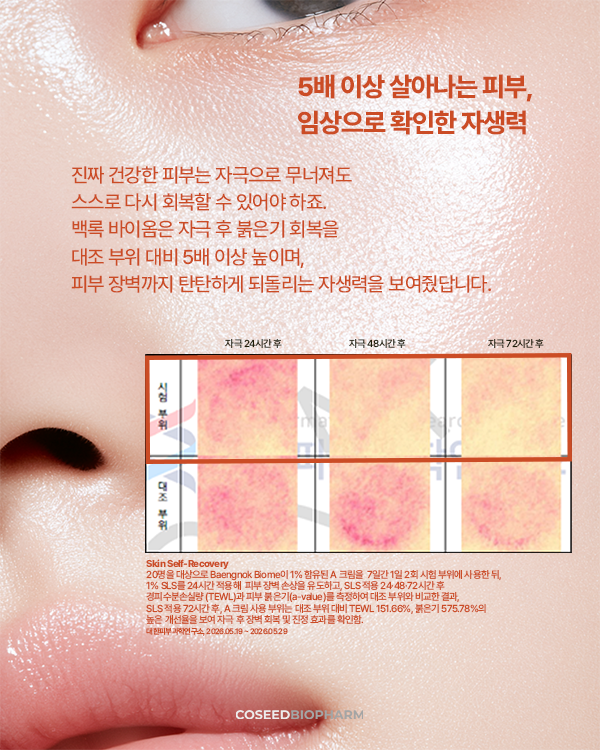
Over 5× Greater Skin Recovery
Clinically Demonstrated Self-Recovery
Truly healthy skin should be able to recover on its own, even after being weakened by external irritation.
Following irritation, Baengnok Biome delivered more than five times greater redness recovery compared with the control area, while also supporting the recovery of the skin barrier.
24 Hours After Irritation / 48 Hours After Irritation / 72 Hours After Irritation
Test Area / Control Area
Skin Self-Recovery
Twenty participants applied Cream A containing 1% Baengnok Biome to the test area twice daily for seven days.
Skin barrier damage was then induced by applying 1% SLS for 24 hours.
Transepidermal water loss, or TEWL, and skin redness were measured 24, 48, and 72 hours
after SLS application and compared with the control area.
At 72 hours, the cream-treated area showed a 151.66% greater improvement in TEWL and a 575.78% greater improvement in redness
compared with the control area, confirming skin barrier recovery and soothing effects following irritation.
Korea Institute of Dermatological Sciences
May 19–29, 2026
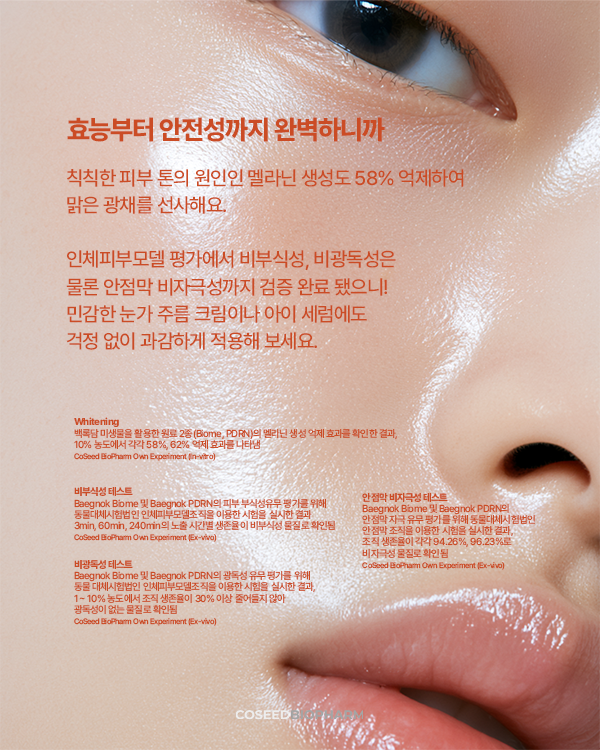
Complete Performance, from Efficacy to Safety
Baengnok Biome inhibited melanin production by 58%, helping promote a clearer and more radiant-looking complexion.
Human skin model assessments confirmed that it was non-corrosive and non-phototoxic, as well as non-irritating to ocular tissue.
This supports its confident application in sensitive eye-area formulations, including anti-wrinkle eye creams and eye serums.
Brightening
The melanin-inhibiting effects of two ingredients derived from Baengnokdam microorganisms, Biome and PDRN, were evaluated.
At a concentration of 10%, Biome and PDRN inhibited melanin production by 58% and 62%, respectively.
CoSeed BioPharm In-House Study, In Vitro
Non-Corrosion Test
Baengnok Biome and Baengnok PDRN were evaluated for skin corrosion using a reconstructed human skin tissue model as an alternative to animal testing.
Based on tissue viability after exposure for 3, 60, and 240 minutes, both ingredients were confirmed to be non-corrosive.
CoSeed BioPharm In-House Study, Ex Vivo
Non-Phototoxicity Test
Baengnok Biome and Baengnok PDRN were assessed for phototoxicity using a reconstructed human skin tissue model.
At concentrations ranging from 1% to 10%, tissue viability did not decrease by 30% or more, confirming that the ingredients were non-phototoxic.
CoSeed BioPharm In-House Study, Ex Vivo
Non-Irritation Test for Ocular Tissue
Baengnok Biome and Baengnok PDRN were evaluated for ocular irritation using an alternative ocular tissue model.
Tissue viability was measured at 94.26% and 96.23%, respectively, confirming that both ingredients were non-irritating.
CoSeed BioPharm In-House Study, Ex Vivo
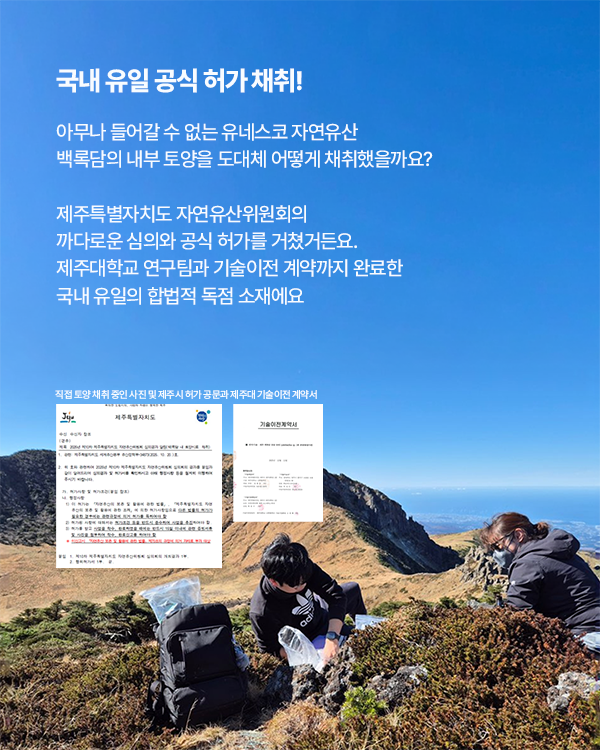
Korea’s Only Officially Authorized Collection
How was soil collected from inside Baengnokdam, a UNESCO Natural Heritage site where public access is strictly prohibited?
The collection underwent rigorous review and received official authorization from the Natural Heritage Committee of Jeju Special Self-Governing Province.
A technology transfer agreement has also been completed with a research team from Jeju National University,
securing Korea’s only legally authorized and exclusive ingredient source of its kind.
Photos of the soil collection process, the official collection permit issued by Jeju Province, and the technology transfer agreement with Jeju National University.
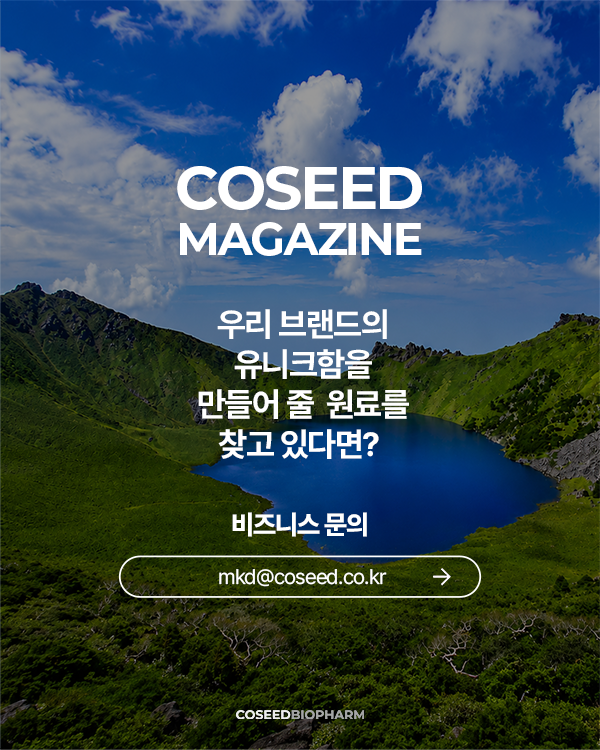
COSEED MAGAZINE
Looking for an ingredient that can make your brand truly unique?
Business Inquiries
mkd@coseed.co.kr
- CEO : Park Sung-min Corporate registration number : 301-81-90229 E-mail : mkd@coseed.co.kr
- Address : 68, Osongsaengmyeong 2-ro, Osong-eup, Heungdeok-gu, Cheongju-si, ChungbukTEL : 043-274-9097FAX : 043-274-9098